Wednesday, May 7, 2014

Even if you aren't Catholic II

From the Sistine Chapel we were led to the Basilica of St. Peter.  For which there are almost no words.  It is absolutely stupendous.  Huge and gorgeous, and of course, crowded with tourists, so that getting a picture without heads or shoulders or whole bodies was a challenge.

We got the little talk that I’m sure every tour group gets about the Holy Door, which is to the right of the main door leading from the portico into the church. (The portico, or front porch, has a beautiful, high, arched ceiling, and from here you can look out and see St. Peter’s Square spread before you, just as the Pope no doubt does before he walks down the steps for this, that or the other ceremony/occasion.)  Anyway, the Holy Door is kept sealed except for Jubilee years -- usually every 25 years -- when there’s an elaborate opening by the Pope.  Formerly masons would loosen the sealant, so that the Pope could just tap the door with a silver hammer for it to open.  But after some loose masonry fell on Pope Paul VI, they made a point of getting rid of all the sealant, so that the Pope would be able to just push on the door with his hands, without a shower of concrete falling on his head. 

They’re not even sure how this tradition originated, but like most traditions, it’s taken on a life of its own.

Inside, after giving us a brief moment to gasp at how huge and splendid the church was, we were led by to the right, where Michelangelo’s famous Pieta can be viewed behind the glass wall that was installed after some deranged geologist (!) took a geologist’s hammer to it, while declaring “I am Jesus Christ!"  It is, indeed, a beautiful sculpture, just as the artist’s David is.  No question, the guy was good.  But it is frustrating to be kept at such a distance, so different from the up-close-and-personal view you are able to have of David.  You simply are not able to see the fine detail.

Then we were led around by our guide to look at this statue and that picture (and, interestingly, none of the pictures you see in the church are paintings, but rather mosaics, that look like paintings), and eventually I did my usual wandering off on my own.  You’re drawn ineluctably toward the colossal dark bronze canopy that looms over the main alter, directly under the dome.  In a way, the canopy doesn’t seem to go with the rest of the décor, which is heavy on the white marble, the gold, the classical paintings (i.e. mosaics), the colored marble on the floor, in the niches that contain all those statues.  To me the canopy looks positively oriental, like a Chinese pagoda.


Like the inner domes of the Duomo in Florence, and the one in Siena, this one is beautiful, with panels of painted saints and other religious folk curving up the dome, separated by narrow stripes of gold stars against a dark blue background.  I’d learned by this time that the “stars of heaven” are a favorite theme of church ceilings.  And of course, as always, there’s the cupola at the top of the dome, with a hole giving you a view into “heaven” beyond.

Here again, as at the basilica in Siena, I got separated from the group, discovered all of a sudden that I could not hear the guide over my headset.  Minor panic set in, as it had in Siena, because I didn’t know where the group was going next, and with the crowds of people, and amount of space to be covered in any search…how was I to find them?  And then, suddenly, there was ever-dependable Gianni, waving his hand at me.  Where would I have been without Gianni!


When we went outside, we found that the area directly in front of the basilica was full of chairs, for some event.  We had to follow a narrow, roped-off path around the center area.  And of course, we were led directly by our guide to the inevitable gift shop, where people got busy buying souvenirs and Vatican guide books. 

And alas, wouldn’t you know that in the one picture I took of the exterior of the church, the dome is hidden by an outdoor lighting fixture!   

But there is no question: the Vatican is not to be missed on a trip to Rome, whether you are Catholic, or as much of an agnostic as some people I could name.

Monday, April 28, 2014

Even if you aren't Catholic...

Monday morning, our last full day in Rome, was given over to the Vatican City.  At the Vatican, which from the street looks like a huge fortress with very tall walls, there was the usual parking of the bus, some way away -- you can never park close to any of these places -- the walk up the street, past all the poor souls who had to wait in the very long line to get tickets, and the satisfaction that comes from knowing that as part of a tour group you won’t have to wait long at all.

You enter the Vatican museums through a very LARGE stone gate that interrupts those high, blank walls.  It’s topped by sculptures of Michelangelo and Raphael.  Inside, you’re surprised to find yourself in a very modern setting: a tall escalator ahead of you, above, a multipaned skylight; at the top of the escalator a wide expanse of empty grey floor, surrounded by bare, charcoal grey walls, modern lighting, and a decidedly functional-looking gift shop, or rather, collection of gift counters.  You pass through security turn-stiles, walk across more floor, though glass doors -- it’s all rather like being in a big, modern train station.  But then, at last, with thousands of other people, you move up the ramp that takes you into the museums proper.

And the gorgeousness begins.  It isn’t just that there are all these exquisitely beautiful works of art everywhere you look, but that every inch of space -- walls, floors, great arched ceilings, staircases, archways, windows, nooks, crannies -- are also exquisitely beautiful, covered with inlaid marble, colored tiles, mosaics, paintings, gilt, etc., etc.  And it isn’t like you’re in museum at all, but rather a very sumptuous palace, that belongs to, maybe, the Sun King.

One of my favorite galleries -- and these are often like wide hallways, rather than rooms --was the tapestry gallery.  Huge things, gorgeous, essentially gold with some color thrown in, and full of story-telling.  This was one of so many times on our tour when I longed to be accompanied by a private guide, who would be able to answer my questions, and give me time to look.  I was also frustrated by not being able to see the tapestries as clearly as I wanted, due, if fear, to a glasses prescription that could stand updating.  But also, the gallery -- like so many of them -- is not brightly lit, no doubt to preserve the tapestries.  And because of the crowds it is difficult to get close enough to take in the details.  So there I was, dazzled, but frustrated. 

The giant pigna (pine cone) in its niche
At one point we were led out into the large Pigna Courtyard, which is named for the giant bronze pine cone that stands at one end, and dates from the Middle Ages.  Why a giant pine cone?  Our guide may have told us (my guidebook doesn’t), but I was busy investigating the much more interesting sculpture in the center of the courtyard.  At first I thought it was a globe of the earth, but it’s actually a gold-and-black sphere within a gold sphere,  Parts of the outer globe are cut away, revealing the dark interior with the second sphere, which put me in mind of a very large ball bearing.  It’s so intriguing that most people take a picture of it, usually with a family member standing in front of it.  But it isn’t old like most of what you see at the Vatican: it was done in 1990 by Arnaldo Pomodoro.

The Golden Sphere, relatively new (1822) gallery in background
We spent far too much time out there in that open, windy courtyard.  Some of us walked briskly off looking for a bathroom.  This exodus was led by Theresa, who was one of the three women traveling alone.  She was chunky, very fair-skinned with short dark hair, and looked to be somewhere in her late 20s.  Everyone was astounded when it became common knowledge that she was all of 42.  Theresa was the most consistently disgruntled member of the group.  I thought it was so unfortunate that she was unable to appreciate and enjoy what we encountered, without complaining about this lack or that inconvenience.

Even when we returned, we still had to wait to go in for our next stop, which was -- ta-dah! -- the Sistine Chapel.  Later I realized that we were “held prisoner” outside for so long because the powers that be will let only a certain number of people into the Chapel at a time, and we had to wait until a group our size could be accommodated (or, perhaps, was scheduled).  However, I also wondered later why they didn't take us to see more galleries while we were waiting!

So at last we’re there, in what is surely the most famous “chapel” in the world.  And I find myself tearing up, simply because I am actually there, looking up at all those paintings I’ve seen in so many art books.  I feel a kind of speechless awe to be looking at “the real thing,” even though I can’t see the real thing very well.  I don’t know how much of this can be blamed on the out-of-date prescription, but there is no question that this was the most dimly-lit of all the dimly-lit sites we visited.  I strained and strained to see things clearly.  It was very crowded, and the only places to sit down -- benches along the two long walls -- were usually full; if you saw someone get up, you grabbed his or her place.  For it was much easier to look up from a sitting, rather than a standing, position.

Because the place is a “holy chapel” you aren’t supposed to talk.  Our guide had given us his little talk before we entered, because of this rule, but some guides would try to stage-whisper their explanations to their groups, only to be shushed by the guards.  For once I did not feel rushed, because once I was able to nab a seat, I had plenty of time to peer all around.  Everything is either high up on the walls, or on the ceiling, so there is not the usual trial of trying to get close enough to see.  Interestingly, the famous picture of God reaching out to give the touch of life to Adam is almost lost in a ceiling of dozens of pictures.  Besides those running down the middle of the ceiling (the God/Adam picture is in the center of those), there are painted columns topped by nude figures separating these pictures, as well as pictures inside triangles just below the curve of the ceiling, with paintings of individuals in the space between each triangle.  The intricacy of it all is stupefying. 

And there is no question that Michelangelo was glorifying the male body.

Friday, April 11, 2014

An unburied treasure

As we approached Mt. Vesuvius, what really got me were all the houses and hamlets climbing its sides.  Living on the flank of a live volcano -- is this ignorance, indifference, a death wish, or what?  I felt the same way about the people living on the island of Santorini, when I visited there.  There’s no question that Santorini is one of the most beautiful places on earth, but its inhabitants are living on the rim of a live (if presently dormant) volcano’s caldera.  Its last eruption was 1950, and the sleeping dragon could awaken at any time.

Ah well, we all have to live someplace.  And is anyplace really safe?

There is a small, modern town of Pompeii; what we saw of it was the street that lies at the foot of the ruins, along one side of which runs a line of cafes, restaurants, souvenir shops and kiosks.  We were provided with a fairly pedestrian lunch at a fairly pedestrian restaurant (and according to Rick Steves, there is nothing but, along this tourist-trap of a street), but at least we were fortified for our two-hour exploration of the ruins.

When we came out of the restaurant, I realized that with the hot sun blazing down, I really should have a hat.  There was a fellow across the street selling exactly that, along with a lot of other stuff.  I walked over, and immediately saw just the thing, a cut little straw hat, with a few flowers in the front.  But I couldn’t see how I looked in it.  “No mirror.”  I said to the young vendor.  “Ah!” he looked around, then with a triumphant expression, led me to a nearby motorcycle.  We all laughed, I peered into the mirror, and a sale was made.  (And I was very glad I'd gotten that hat)

As usual, we had a local guide, taking the place of our regular tour guide.  He was a very old man, very knowledgeable, who nonetheless kept moving us along at a quick pace because (as he mentioned more than once) we had a lot more to see, and not much time.  At the end of the tour, I admitted to myself that the fellow had impressed me with how much ground and information he had managed to cover, without flagging, under a hot sun, and with a lot of straggling tourists in tow (eventually he stopped trying to make sure we were all with him, and just kept going, leaving us to catch up as we could).

So first of all, Pompeii is huge.  Much larger than I expected it to be.  But after all, it was a thriving city of 20,000 when Vesuvius buried it in 79 A.D.  Everywhere it is a matter of grey roofless walls, the grey of rock and stone used to build the shops and houses -- the finer houses and public buildings would have been faced with marble.  In a few cases, parts of homes have been restored to give you an idea of how the building looked in its prime.  But even so, you can't really get a good idea, because some of those houses had many rooms -- 10,12, one even had 40! -- but you're seeing only a very small part.

There were a number of things that really caught my attention.  The way you could stop in the middle of a street, look to the right and left, and see ruins stretching away from you on either side.  The high stepping stones that enabled people to cross the streets when they were being flooded with gushing water, to clean them.  (Carts that went down the streets straddled the stones.)  One stone in the street indicates it was a one-way street, two stones means there was two-way traffic, three stones, a major thoroughfare.


    City of Stone       


Lupanar -- Wealthy clients upstairs
The fact that the brothel area is now (as it probably was then) one of the most popular areas among visitors.  People crowding into the doorways of the small, dark rooms to let their imaginations take over.  One building, Lupanar, -- which is the latin word used for brothel, but literally means “wolf den” -- has been restored, and we passed through its dim interior, to gaze at small bits of barely discernible, but very explicit, erotic mosaics on the walls. 

And the way almost everywhere you are, there is a view of the deadly mountain, seemingly not that close, but obviously close enough (it’s five miles away).

We went through one of the public baths, seeing several rooms, very cool and dim, whose names suggest what they were used for: the frigidarim -- no doubt especially appreciated on a hot summer’s day -- the tepidarium, the calidarium.  There had been colorful friezes on the walls; in some places you can just make out some faded color.  We were seeing just a small part of this bath -- it would have contained many more rooms -- changing rooms, the female side of the bath,  even rooms for gymnastics (a little exercise, before washing off the sweat with a bath).

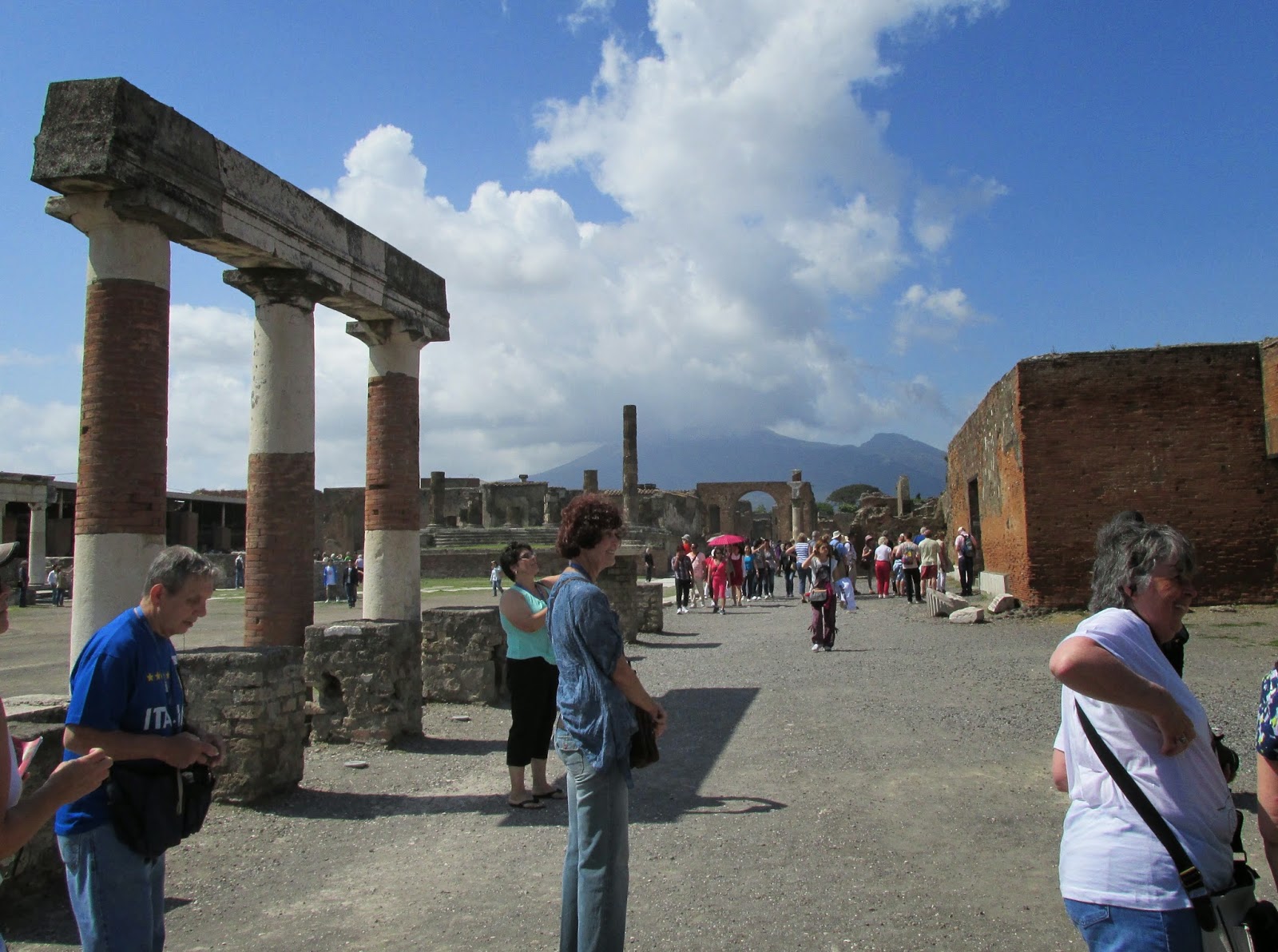
Eventually we reached the forum, once the political, commercial and religious center of the city, now a large open grassy area -- which would have served as the marketplace -- surrounded by suggestions of the temples and public buildings that once stood there.  In one of these is to be seen a glass case containing the plaster cast of one of the carbonized victims of the disaster.  It is disturbing to look at the figure lying on its side, its face screwed up in agony, its hand reaching out.  It would be far worse if one were looking at the actual body.

Two hours is really not enough time to see all the places mentioned in ones guidebook -- as with so many other sites we visited I longed for more time -- but even this taste, this glimpse, made me happy.  I had seen one of the most unusual, fascinating places in the world.
The Forum, with Vesuvius, clouds like smoke, in background
 

Wednesday, April 2, 2014

Heading south

All right, I’d seen one ruin that I had been eager to see, but there was still that ruin of all ruins, Pompeii.  Sunday was our free day, and while most folks had someplace around town they wanted to visit – most planning to go see the Pope when he made his weekly appearance in the square in front of St. Peter’s – the one Jewish couple in the group (who were Pat’s and my ages, were blond, fit, and looked at least 10 years younger than we, which we thought very unfair) were off to see the Jewish Quarter – some opting to just rest and relax at the hotel.

But I and about four other people were going to Pompeii.  Indeed, that had always been one of my primary objectives in visiting Italy.  Those of you who know me know that the older something is, the more I’m interested in it.  That’s why I so loved visiting Greece, because so much of what one sees there is so old, it’s nothing but a bunch of stones.  But stones that let your imagination take over, and fill in the blanks.

But initially it looked like we weren’t going to be able to go, because Perillo Tours’ tour did not “make;” not enough people signed up.  The people at the front desk did have a brochure put out by Green Line Tours, which offered a day trip to Pompeii (and which, I later learned, got mainly scathing reviews on TripAdvisor).  The problem with it was that it lasted 12 hours! 7 a.m. to 7 p.m., an excruciatingly long day for someone who tires easily.  Mainly the trip was so long because it included a stop in Naples, which I wasn’t particularly interested in seeing (who has ever heard anything good about Naples?), as well as at the inevitable gift shop, officially a “factory” where cameos are made.  Now cameos I do like, but as I knew I wouldn’t be buying any, I felt impatient at this addition. (Note that when it came down to it, the stop actually proved enjoyable, if too long.  We were given a little explana-tion/demonstration of how cameos are made, and then allowed to wander through two rooms full of beautiful jewelry and other objets d’art, which delighted the eye, even if one could not afford to purchase any.)  

Well, there was no way I was going to come all this way and not see Pompeii, so I signed up.  Gloria and Diana, two ladies I have previously mentioned, also signed up, as did the assertive Bonnie and her silent husband, Bud.  Patricia decided not to go, and ended up having a very pleasant day doing essentially nothing with her friends, the IRS couple.

When we left Rome we passed a huge ghetto of high-rise apartment buildings that made me think of the low-income “projects” that mar the southern tip of the Bronx.  But once we got past this dismaying bow to modern city planning, the bus ride south was as pleasant as the ride from Florence to Rome had been.  There is no question that Italy is a beautiful country – at least those parts we saw!  Leaving Florence the highway had curved its way down out of the hills that surround that city (which is in a kind of bowl); the landscape that rolled by was thickly forested, with occasional glimpses through the trees of farms down in the small valleys.  It was much like what we had seen between Bologna and Florence.

Then the land opened out, green farmland stretching toward that backbone of Italy, the Appenine Mountains, on our left.

Traveling south from Rome the Appenines appeared as blue hills on the horizon; separating us from them were green valleys with their tree-dotted slopes, the now-familiar ochre-colored farmhouses with their red terra cotta roofs, the plowed fields, and inevitable vineyards.  By the time we stopped for breakfast (which no one had had time for, since we had to leave the hotel at 6:30, in order to get to the Green Line office to catch our tour bus by 7) the hills had moved in, and were suddenly serious mountains, with fat clouds resting all along the tops.   It occurred to me that visiting those mountains might immerse one in a more rugged landscape than the lovely but very domesticated one we were seeing. 

As we continued our journey, I noticed that the precise cone shape of some of those mountains made their volcanic origins apparent.  And I thought, but of course, we’re moving toward one of the most famous volcanoes in the world; there would certainly have been other volcanos in the neighborhood, once upon a time.

Naples itself surprised me.  Coming into it you are driving past acres and acres of unprepossessing apartment buildings that look like stacks of ice trays.  I realized that look was produced by all the dark brown balconies jutting out; they make it seem like the story above is set on a “tray” below.  Everywhere there are clothes drying on those balcony railings, or on small lines stretched across a family’s section of the balcony. 

However, parts of the city are quite impressive.  We drove down to the bay, for a photo op.  Beautiful view, though the bright sun was in the wrong place to get a good shot of Vesuvius, across the bay.  But the slumbering volcano was big, looming, a dark blue.  Knowing what it was capable of made it seem sinister.

Behind us, across the road from the bay, was a long, narrow park full of people and palm trees.  When I faced that way I saw buildings piled upon buildings, climbing the crescent of hills that curve around the bay.  They say Rome is built on seven hills, but you’re not always aware of them.  The hills of Naples are very evident indeed.

Farther along the curve of that road were the huge cruise ships, parked at docks that lay at the foot of a genuine medieval castle.  Castel Nuovo was built 1279-1281 by Charles of Anjou (i.e., a Frenchman), when he became king of the kingdom of Naples.  It’s had a vigorous and interesting history, and there it stood, in 2013, surrounded on three sides by thick, handsome, Victorian era apartment and office buildings, and building cranes.

The bus drove in a circle around the fountain of Neptune (we saw lots of fountains), and then it was time to move on.  I decided our short visit to this ancient city (first settled by the Greeks in 600 B.C.) had not been such a waste after all.  But now it was on to Pompeii, 17 miles down the road.
Castel Nuovo (Professional photo)
 

Thursday, March 13, 2014

Ah, Roma

Rome took me completely by surprise.  It is magnificent.  I usually reserve that word for mountain vistas, but this is one magnificent city.  Everything is on a grand scale.  Beautiful, big, old  buildings, with huge arcades along the ground floor (we’d seen arcades in Florence, intended to protect citizens from the sun as they strolled from place to place, but none with such high arches and ceilings), most of the apartment buildings with balconies, many with awnings that can be dropped down to protect from the morning or afternoon sun,  lovely, tree-lined boulevards, the real, live Colosseum,  which is surely, like the Eiffel Tower in Paris, the universal symbol of Rome, the astounding Vatican (which, I realize, is actually its own little country, but when you’re there, it’s just a part of Rome), the legendary Tiber River (Tevere, to the Italians), which is crossed by numerous lovely stone bridges, both palm trees (which surprised me) and what we learned from one of our guides are called umbrella trees, because they look like opened umbrellas (we saw many of these on the drive down from Florence, evenly spaced, marching like soldiers along the tops of ridges), lots of roofs gardens, here and there lush greenery spilling over garden walls.  Also, of course, lots of traffic.  Tourists everywhere – and tour buses – but also lots of locals, who somehow manage to look both intense and blaze.   

The Hotel Rose Garden Palace, where we stayed, is across the street from the U.S. Embassy, which should give you an idea of our neighborhood.  Very nice.  Trees lining the streets, providing valuable spots of shade when one was out walking in the bright, hot sun (except for about an hour in the middle of the day in Venice, this was the hottest weather we had thus far encountered).   A few blocks away, the  large and lovely Villa Borghese Gardens, a park we were to drive through on our way to somewhere or other, and which features lots of folks jogging, riding bicycles – and horses! – pushing baby carriages, relaxing in the grass.

The hotel itself was a bit on the coldly elegant side for me – white marble everywhere, but not enough furnishings or decorative touches to give it any warmth.  And we were all dismayed at the failure to provide wake-up calls – there was an automated system on the room telephones, but it never worked.

The first place on our agenda was the Colosseum, visited the afternoon of our arrival.  After something of a drive through the streets of Rome, we found ourselves on a street that looked down at this universal symbol of Rome.  Oh, wow, there it was.  As we curved down and around the ruin, we saw that part of it was simply not there.  Indeed, the whole outer wall, which is four stories high, rises up along only half of the structure.  Large brick wedges have been built to shore up the outer wall at each end of its curve.  We learned from our guide that long after the Colosseum had ceased to provide Rome with gory entertainment, it had served as a convenient quarry for the citizens of Rome.  They would simply come and cart away whatever kinds of building materials they might need.  When you see pictures of this truly colossal celebration of the worst aspects of ancient Roman culture, they usually do not show the missing bits.  

The Colosseum was built of limestone, brick, something called Tuff or Tufo (no, not tofu), which was a porous stone used for some minor pillars, and in the preparation of cement, which the Romans had only recently discovered – that was used for the vaulted arches holding up the ceiling of the corridors that encircle the arena.  And there was marble, for the seats, statues and drinking fountains (!), all long since gone.  Back in the day, each of the hundreds of arches you see facing the street on the second and third levels would have contained a marble statue.  That’s a lot of marble statues.  When you’re up close and personal, you can see this mishmash of building materials...everything but the marble.


Inside the Colosseum
Back in the day there were also 80 entrance arches, which was certainly a good way to get up to 50,000 people in and out efficiently.  No such efficiency today: all the thousands of people who pour into the structure every day must pass under the same arch, in line, then move slowly around the curve of the building – still essentially “in line,” with security guards regarding them blankly-- until they reach an open area, from which they are free to go where they will, or where their tour guide takes them.  We made our way up a couple of flights of stairs, and came out at the second viewing level.  From here you can get a good overview of the whole.

For all that it is very much a ruin, it is still impressive as hell.  Probably especially so because the floor, which would have covered the cells and corridors beneath, is no longer there, and you can see those cells where animals and doomed humans were kept, the corridors along which they were led to their deaths.


Cells and cages, beneath floor of arena
Reconstruction of part of floor can be seen in rear
A bit of floor has been rebuilt at one end, so you can get an idea of what it looked like.  There would have been sand on it, for gladiator fights, and animals tearing into human beings, but there might also be an imitation jungle, with animals being “hunted,” and slaughtered.  Indeed, more animals than humans were killed here, and in other amphitheaters throughout the Roman Empire.  And by the way, the Colosseum was originally named the Flavian Amphitheater, in honor of  the emperors who built the thing, who were of the house of Flavius.  This was long after the days of Julius Caesar, or Augustus Caesar, or any of those emperors we’re all familiar with; the building was completed in 80 A.D.

It came to be called – one might say nicknamed  -- the Colosseum because of the colossal bronze statue of Nero that stood out front.

One thing I wondered about were what looked like concrete roofs slanting down to open archways.  Turns out those “roofs” once upon a time lay beneath the marble seats.  The black holes you see every now and then among the roofs are where people would enter the arena from the stairs that climb up from the corridor on the ground floor.  Where the mysterious substance is missing, you can see the evenly spaced slanting brick walls that held up the slanting tiers of seats.  You really miss the presence of seats, but a book I purchased in the gift shop on the third level does a good job of showing you what the place looked like then – complete with seats – and now. 

"Roofs" that once supported marble seats
No question: a great place to visit.

Saturday, March 1, 2014

Getting Un-lost, to see the guidebooks' favorites

After a few minutes of genuine concern – good grief, how was I going to find the group if  I couldn’t even hear the guide over my headset? – I suddenly remembered that the other major sight we were to see was the main piazza.  And since the Duomo sits at the top of the town, I figured my best bet was to follow the meandering street we’d come up, down, and surely, at some point, there would be some indication of whence lay one of the most famous city squares in the world.

And sure enough, I hadn’t meandered long when I saw that, at a fork in the street, most of the people were going off to the right.  And I was pretty sure we’d come up that street on the left.  So I went right, with the crowd, and a couple of minutes later I could hear snippets of lecture coming over my headset.  And in another couple of minutes I came out into the bright sunshine pouring down into a vast open area full of people.  And over to my right, being lectured to, I spotted my group.  Oh, frabjous day, I was un-lost.


Piazza del Campo
But now that I knew where they were, I took a moment to take in the scene.  The main part of the Piazza del Campo is this huge shallow bowl, not circular-shaped, but rather (as my guidebook helpfully suggested) fan-shaped, the straight line of the opened fan running in front of the Palazzo Pubblico (City Hall).  The brick bowl slopes gently up from there, and people sit about here and there on the sloping bricks, even lie back to soak up the sun.  All around the rim of the plaza are cafes, restaurants, pizza shops, sidewalk vendors.


Palazzo Pubblico (City Hall), Siena
I have to say something about the City Hall building.  It is somewhat like the one in Florence, though not quite so awkward-looking.  The one in Florence, whose official name is the Palazzo Vecchio, dates from 1322, the one in Siena from 1342, which undoubtedly accounts for their similarity.  The one in Florence  is this big, flat-faced square building, topped with a crenelated roof,  in the middle of which stands a very tall bell tower, which I must say looks spectacularly phallic.  The Siena City Hall is wider, and lower; it’s proportions are more pleasing, and the bottom floor is saved from the blankness of the rest of the building by a line of white arches.  But its bell tower is very tall, and sits far to one side, completely negating those pleasing proportions.  I’m including pictures of both, so you can decide for yourself which is more attractive.  Much is made of both buildings, which were the center of civic life in the middle ages, and are still.  For me the most impressive thing about them is that they have been standing, and functional, for almost 700 years.
Palazzo Vecchio (City Hall), Florence

But as to Il Campo itself (its name, The Field, comes from the time when it really was a field, outside the city walls): its biggest claim to fame is the Palio, a horse race held there every July 2nd and August 16th.  Thousands of people crowd into this piazza, and spill over into the narrow side streets, to watch this race.  The riders ride bareback, around the embankment that circles the sunken piazza.  There’s a picture in my Eyewitness Travel guidebook, and I can’t believe all the people – it’s like Times Square on New Year’s Eve, but more concentrated.  Can’t see how most of those people could see the riders, never mind the horses.  And apparently those cheering fans can’t go to the bathroom, because someone said no outdoor facilities are provided.

And what does the winner of this spectacular event win?  A large banner (which is what “palio”means).

When I rejoined the group, I got a number of “There she is!” and Gianni assured me that as soon as he had dismissed everyone for lunch, he had planned to come looking for me (I really was the bane of his existence). Pat and I settled at an outside table at one of the cafes, and did a little people watching, while consuming a perfectly nice lunch – one of those moments that I said earlier we didn’t get enough of on the trip.  Then we went looking for a bank, as I was drastically low on cash, and it really is better to deal in that than in credit cards, especially in small shops and cafes.  I looked up how to say “bank” (una banca), and was directed up a kind of alley lined with shops to the narrow, hilly streets beyond, where we wandered for a while, trying to find that banca. When we did, we found we couldn’t get into the little vestibule where they had the ATMs, because you needed a card key to get inside.  When a lady came along and helpfully used her key to get us inside, we couldn’t get the ATM to give us any money.  A frustrating 15 minutes, especially since we both felt we should be exploring.

When we returned to the group it was time to go (off to the wine tasting, see Note of July 27, 2013), which did not set well with most of us in the group; we simply had not had enough time to explore this fascinating, ancient little city.  One should have at least a full day; we had about four hours.  A word to the wise.

A final note: as we were walking back to the bus – here, as elsewhere, tour buses must park a good way outside the historic areas to be visited – I spotted an ATM on the outside wall of una banca.   I rushed over to use it, and right behind me was another member of the group, who had also not been able to locate an ATM earlier.  The group just kept going, which annoyed us both.  Ben, the fellow with me, a big, bluff  man who had appointed himself class clown -- and often was quite amusing, in his blank-faced way -- was not amused now, especially since the group had waited for one of our members while she slipped into a sweet shop to buy some candy.  He grouchily muttered “For her they could wait," while I was looking over my shoulder, and seeing with relief that Doug, a tall fellow from Texas who always wore a baseball cap, was waving it in the air as he walked on, so that we could see to follow.  The group really had gotten good about looking out for one another.

Wednesday, February 26, 2014

Onward and Upward

I’m sure those of you who were following my Italian saga with some interest, at least, gave up hope long ago that I would continue.  This failure to get on with it, to finish a writing project, has long been a problem for me.  I admit to lacking the expertise to explain this phenomenon, unless it is that I am just plain lazy.

At any rate, to “get on with it” at last: I would have to say that Siena is a must-see, if you’re going to Italy.  It is genuinely old, and looks it.  You feel as though you’ve stepped back into a medieval city...and in fact you have.  Following their defeat by the Florentines, backed up by the King of Spain, in 1555, the Sienese were forbidden further commercial development, with the result that the city became something of a backwater, frozen in time.  You walk up and down hills on narrow, brick streets, lined mainly with brown stone buildings, cheek by jowl, generally about four stories high.  Indeed, many of them look like the Palazzo Davanzati, that we visited in Florence.  There was one excellent viewing place where we paused and looked out at a blanket of reddish-brown terra cotta roofs.

Of course we saw churches, two of them.  And  I’m sorry, I’m sure you’re all tired of visiting churches, but that seems to be the main thing tour companies are concerned with showing you.  At least that’s the case with Perillo Tours.   The first, San Dominico, is dedicated to Saint Catherine, the patron saint of Siena (who “took the veil at age 8!”); and as with other churches I saw in Italy, I was not much impressed.  Not only was the interior the usual big, dim, bare, and plain, but the outside was of a dull red brick, looking almost like a fortress, rather than a church.  The most noteworthy thing about it is that is houses the head (!) of the saint, in a gilded marble tabernacle on the altar.  Really, this veneration of saints’ body parts can be taken too far.

We wound our way up hill to the main church of the town, or the Duomo.  Now this is an impressive church.  The exterior is similar to the Basilica di Santa Croce, in Florence, (See Note of Sept. 14, 2013) well worth a picture or two.  But the interior dazzled me.  Striped columns!  The result of alternating black marble with white.   And the floors were gorgeous, with religious scenes or large medallions of inlaid marble the length of the nave, and on the floors of the transept; as well as black and white checked frames around mosaics of the Sibyls (i.e., prophetesses of the ancient world), along the side aisles.  Under the dome -- which is encircled partway up by religious folk carved into little niches – the striping continues above the pillars and arches, which gives the dome area an exotic look, especially with the large gold gilt statues that stand atop a striped pillar in each corner.  And the dome itself, instead of being a swirl of figures depicting scenes from Christ’s life, as in the dome of Florence’s Duomo (if you’ll recall, the most noteworthy thing I saw inside that huge church), is an aqua “sky” full of silver squares framing gold stars.  And way, way up there, an “eye” of gold, beyond which are small windows and a golden sunburst.  An invitation to vertigo, if there ever was one.

Siena Cathedral - Professional Photo
All of this “busy-ness” throughout the church gives a kind of mid-eastern look to the place.  Persian?  Maybe even Egyptian?  Most definitely not your typical Italian church.

Our group squeezed into the exquisite, but very small, Piccolomini Library, off one of the side aisles.  Another stunningly beautiful place.  Vividly painted frescos all over the walls, and the ceiling, and for once you could see them clearly.  The room was very light. We were informed that the paintings – most of which date from 1502-1507 – had never been retouched, or even cleaned; but it looked as though the artists had finished painting them yesterday.  They depict scenes from the life of Pope Pius II, but what I loved about them was 1) the obvious joy of the artist in fully utilizing the concept of perspective and 2) the view they gave you of how people looked and dressed in the late 15th, early 16th centuries.

All around the room, on the lower part of the walls beneath the paintings, were opened illustrated manuscripts, with all that elaborate lettering and colorful, carefully executed scenes at the beginning of each page.  The only other books I saw were a few historical books in a display case in the middle of the room (which crowded us even more than might otherwise have been the case).  But for all the lack of books, it’s a humdinger of a library.

I was so impressed with this church I knew I had to get a colored guide book.  The group was on the way out, but I dashed into the little gift shop, sure that someone had seen me go.  It took an unusually long time to buy my book, because there was a woman ahead of me who went on chatting and chatting with the person behind the counter.  But the book was mine at last, and I dashed outside only to find…no group.  I looked and looked, first from the height of the steps leading up to the church, then up close and personal as I wandered through the crowds in the piazza, searching for a familiar face.  And the worst thing was, I couldn’t hear anything on my little headset.  Oh, my goodness, they’d gone and left me!

Saturday, September 14, 2013

Yes, another church, but with a difference

After Pat and I finished our excellent meal at Ristorante Boccadama, Pat decided to check out some of the shops around the Piazza di Santa Croce.  I, as usual, needed to find a bathroom.  And, no, I don’t know why it didn’t occur to me to use the restroom in the restaurant.  I think it was actually a matter of standing there at the little leather goods kiosk next to the restaurant while Pat decided on a billfold to buy her son, and then our standing there trying to decide what to do next, and it suddenly hitting me that I needed to go.  Since I wasn’t interested in shopping at all (I never am), we agreed to meet at the large statue on the steps of the church, as we had been instructed by Gianni.  I then made a beeline for the church – whose façade looks like the Duomo on a small scale, and is almost as beautiful – figuring I could surely use the toilets there.  But alas, unlike at the Basilica of Saint Anthony in Padua, at Santa Croce you had to pay to get into the church, to get at the restrooms.  So I forked up six Euros, to go to the bathroom.


However, when I took a look at the little booklet I’d picked up at a table by the ticket
Michelangelo's Tomb
booth, I was glad I’d paid my six Euros.  Because one of the claims to fame of this church is that it contains the tombs of a number of celebrated personages, including Michelangelo, and Galileo.  I mean, oh, wow.  To be looking at the tombs of one of the greatest artists in the world, and one of the greatest scientists.  Many people are not impressed by tombs, but I am.  Because this is the closest you can get to someone who is dead.  It’s why I have trouble with the concept of being cremated, and having your ashes dumped out into the wind on a mountain top, or at sea.  Where do people go later to feel close to you, and in some way, commune with you?  With a tomb – whether it’s an elegant sarcophagus, surrounded by elaborate sculpture, as in these cases, or a simple stone in the grass – you have a concrete place to focus on.


Galileo's Tomb
The church itself is less stark and bare than the Duomo, with a handsome dark wood ceiling, and narrow, sort of brownish-green columns holding up the graceful arches along the nave.  But it’s the apse, at the far end of the church, that is flat-out gorgeous.  I could tell this, despite all the scaffolding covering it up (it helped to later see a picture of it in my Florence guide book).  The usual rich colors, covering every inch of wall, a gorgeous gold alter, and windows full of deeply colored stained glass (at last, beautiful stained glass!)  They were obviously doing some restoration work on all those frescos of saints climbing both the outside and the inside of the huge arch that led to the apse.  I found it rather fascinating, watching the men and women up there in their white coats, looking like miniature people, dwarfed by the elaborate scaffolding, and the architecture surrounding them.  I thought, what a fascinating, if tedious, job, restoring all that beautiful artwork.

So I got my quick view of Santa Croce – would have wandered a bit more, but nature was screaming – went out to the cloister, where les toilettes always seem to be located – found I couldn’t figure out how to keep the door to the stall locked, so the lady at the front of the line kindly held it closed for me, and finally made my way out to the statue where we were all supposed to meet.

Only to discover that when Gianni kept referring to the “Pantheon” earlier, telling us we would be visiting it after lunch, he was talking about this church. Due to all the famous people buried there.  So the place I had just paid 6 Euros to visit on the run, the rest of the group was to get into for free.

Ah, well.  Since Gianni had also said our next stop would be some museum, and I was pretty museumed out, I took this opportunity to return to see the interior of the Duomo (See Note of August 6, 2013) .  When I exited there I boldly asked the guard at the door “Dove’ un taxi?”  I didn’t understand his answer, but I understood the pointing well enough.  I made my way out beyond the pedestrians-only streets to where the traffic plowed by (often interrupted by pedestrians) and was lucky enough to spot an empty cab stopped for a red light.  I went up and tapped on the window, the driver looked over at me and nodded.  When I got in I told him exactly what Gianni had told me to say: ”Hotel Villa Maid’-ee-chee, per favore’.”  And then watched as the driver made his way with great panache through the crowded, narrow streets, full of scooters and bicycles that zipped in and out amongst the other traffic.  And finally I ventured to ask “Parla englesee?  He glanced back at me and said “un po,” which is what they all say.  So I said, “I think you must be very brave to drive a taxi in Florence.”  He laughed, gave a very Italian shrug and said “It is nor-mal”.  A ride in a taxi with a real Italian driver, how cool is that?

And when she got home, after a very long day, Patricia collapsed onto her bed and declared, “The stupid museum was the Gucci Museum.  With a gift shop, of course.  A total waste of time.”

Saturday, August 24, 2013

Mangiare!


A lot of people have asked me about the food in Italy.  “Was the food great?”  Speaking from my own experience I’d have to say: not really.

What I ate the most of were ham and cheese sandwiches – un panino al fromaggio e proscutto – the best I could do in the way of portable snacks for when hunger struck at inconvenient times.  But these were not on our kind of bread; the ham and cheese (and sometimes lettuce) are in a kind of pocket, long and narrow, and crispy, especially if the vendors pop it into some kind of a toasting machine, which they usually do unless you stop them.  Really not bad.

I’ve already mentioned the excellent dinner several of us had at Anima Bella, our first night in Venice (See Note of June 2, 2013), and the mediocre meal we had our second night, at Al Giglio, in the Campo Santa Maria Zobenigo (Note of June 17, 2013).  And by the way, I didn’t stay for the main course, as I slipped out and went to the concert, but Pat told me the beef steaks that most people ordered – rather than the fried calamari – were tough.  The place gets mixed reviews on TripAdvisor.  But the lunch Pat and I had in Florence, when we were all set loose for an hour and a half, after visiting the outside of the Duomo and the Baptistry, was one of the best, and most Italian  meals I had while in Italy.

This was in one of several small restaurants (and many small shops) that rim the large Piazza di Santa Croce, at the far end of which is another beautiful church, the Basilica of Saint Croce, which we were to visit later.  But right now—after pointing us in the direction of a large leather and gold goods market (like the glassblower’s shop in Venice, and the souvenir shop we were steered to after visiting the Vatican, there was always someplace that you suspected had an “arrangement” with Perillo Tours) – Gianni encouraged us to have lunch somewhere around the square.  Pat and I settled on the Ristorante Boccadama, a rustic looking little place with a long narrow front room, that held a few tables for one person, a bar at the back, and around the corner a long, narrow dining area, with two small tables pushed together on either side of a central aisle.  We were seated at a table with two men next to us – whom I fairly quickly ascertained were a middle-aged American, trying to both get to know and charm his younger – though not young – potential playmate.  But as in all such seating situations, the two sets of strangers maintained an invisible curtain between them, so as to preserve a sense of privacy.  And next to us was a whole wall of bottles of wine.

What I ordered was the Tuscan sausage dish, and it was out of this world delicious.  A huge coiled rope of sausage on top of beans in a tomato sauce.  There was so much, I offered some to Arthur, one of our fellow Perillo Tourists, who was sitting across the aisle with his wife Madelyn and his sister-in-law.  These three had become to a certain extent Pat’s best friends – she always tended to sit with them, in dining situations (whereas I tried to mix more, sitting with different groups each time), and to walk with them as we were “touring” especially when I had done one of my disappearing acts.  Arthur and Madelyn sort of fascinated me because they were both retired from the IRS.  I mean, how often do you meet someone who has worked for the IRS, never mind a married couple that has worked for the IRS?

Anyway, Arthur had ordered pasta, and as usual it was this huge mound, with nothing but tomato sauce, so he was delighted to be able to add some sausage to it.  And after I got back home, and checked TripAdvisor, I found that this little restaurant that Pat and I just wandered into, gets universal rave reviews, with many people saying what I did: best meal I had in Italy.

We also had dinner at two of the hotels where we stayed.  At the Grand Hotel Villa Medici, there in Florence, the antipasto (what we would call the appetizer) was this very tasty, unusual little pale green mound of who knows what. It looked like it should be sweet but was actually delicately herbed. Then came the pasta dish – lovely little squares of ravioli, stuffed with ricotta cheese, and covered with a fine, thin sauce.  My idea of of a manageable pasta course.  But then came the main course (which Rick Steves, in his travel guide, says is almost always a disappointment), and while they called it veal, it neither looked nor tasted like veal, nor was it as tender as you expect veal to be.  What it looked like was a thick slice of rare roast beef. The little joke I made (that did get a little laugh) was that I suspected this wasn’t young calf, but adolescent cow.  It reminded me of ordering veal in Greece, where it always looks more like pot roast.

The final blow was that dessert was vanilla ice cream.  Vanilla ice cream!  How pedestrian.

Our dinner at the Rose Garden Palace Hotel in Rome was of a similar caliber.  My main course of fish was quite tasty, but not noticeably Italian.  And there was the usual impossible pile of pasta.  Perhaps the best aspect of both of these meals were the plentiful bottles of red and white wine, and carafes of water, on all the tables

Of course, it could be argued that one rarely gets really spectacular meals at hotels, even first class ones (Pat and I stayed at the very expensive Boston Harbor Hotel, the night before we flew to Italy, and were quite disappointed in our dinner).  We did have a very good dinner our last night in Rome, when we were taken to a small restaurant, called all Arco di S. Calisto, deep in an area of very narrow lanes full of restaurants and artsy-craftsy shops, the Trastevere.  Another long, narrow room, where tables were pushed together to accommodate us all.  One thing I really liked was that they put a huge bowl of excellent salad – all kinds of good stuff in it – at the end of each table, for us to “pass down” as needed.  Once again there was too much pasta – if you don’t like spaghetti with tomato sauce you should probably steer clear of Italy – but the fish I ordered was quite good.  Again, not noticeably Italian.  But perhaps I just don’t know what to expect in Italian cooking.  Except, now that I’ve been there…pasta.

Tuesday, August 6, 2013

The place with the big red dome

The famous Duomo (cathedral), which we visited after we left the Accademia Gallery, is first of all huge.  We came upon it from the side, and looking down its length, it seemed to go on forever.  It is even more magnificent on the outside than pictures of it suggest.  (The inside is less so, but more about that in a moment).  Particularly the façade: the multicolored marble – did I mention that everything in Italy seems to be made of marble? – is so striking, so different from the grey stone I was accustomed to seeing in French cathedrals.  When you’re standing looking up at it, it seems to be striped, but that’s a trick of the eye, caused by the long white marble panels trimmed in green marble.  These panels running up the sides, the front of the building, one atop the other, form green and white stripes. And there is also some rose-colored marble mixed in there, especially in the tall, square camponile (bell tower) that stands next to the church.

At the same time that you’re marveling at all that color, you are almost blinded by the whiteness of the vast central entrance, the two smaller arched entrances to either side.  And there are white niches containing sculptured figures on each side of the arches, and just below the roof. The large round windows above the pointed side arches, and the even larger window above the central arch, give a wonderful symmetry to the whole.   

Interestingly, though the church was built over a 140 year period (1296-1436), the marble facing on the façade (which is so gorgeous) was re-done in the late 1800s.  Can't help wondering what it looked like all those years. 

So I was busy snapping pictures, like everyone else, but oh, those crowds.  Losing one’s group was a real fear, and a real possibility.  At one point, when our guide was going on and on, as he had about David, I took the opportunity to sit down on a step of the church and finish the sandwich I had started eating when we were at the Palazzo Davanzati (as I’ve said, my need to eat frequently was a constant pain).  I heard the guide switch from the Duomo to the Baptistry, which is a few steps from the church, and is the place where babies in days of old had to be baptized before they could enter the church.  The most famous feature of this small, octagonal-shaped building are the double doors carved by the artist Ghiberti, over a 27-year period (these artistic masterpieces took a long time to produce!)  The doors are made up of 10 gilded panels beautifully carved with stories from the Old Testament. Most of us who took art history in college have studied these doors, and it was nice to be able to see them in the flesh, so to speak.  But as a matter of fact it was difficult to see them because of…you guessed it… the crowds.  Every picture I tried to take was obscured by heads, bodies, some group leader holding up a sign with a number on it so his group would know where he was.

I would have loved to be able to patiently wait until those pressed up against the gold-painted bars
Ghiberti's famous doors, completed 1452
that protect the doors from the hordes (and possible vandalism) had moved away, so that I could inch my way up to that barrier, and actually study the panels for a few minutes.  But alas, I was losing the guide’s voice – it was fading in and out on my little headphones (which I now had, thanks to Gianni coming equipped with a couple of spare ones) – and looking around, I couldn’t see a single member of my group.  Yikes!  Had they gone into the Baptistry?  I circled the place, searching for the entrance; when I finally found it, saw that there was a 5 Euro entrance fee.  No, surely they hadn’t gone in there.  So I returned to where I had started and there, praise the lord, was Gianni, looking around for me, waving when he saw me (and not for the last time). 

But wait, the group was moving off down the street.  I ran up to Gianni and exclaimed (literally exclaimed) “Gianni, we aren’t going into the Duomo?!”  No, he said, “There isn’t time.”  This absolutely flumoxed me.  How could you take people to see one of the most famous churches in the world, and not take them inside.  When I said this to Gianni he agreed with me, and said that when I got the email from Perillo asking how I had liked the tour, I should mention this.  “Because they won’t listen to us,” he said, meaning the guides. 

Alas, I never received such an email, never got the chance to voice my dismay at this egregious omission.  Perhaps if the guide hadn’t spent so much time on David, there would have been time.  Listen up, Perillo Tours.

I later went back by myself.  I was pleasantly surprised at how minimal the crowds were, how non-existent the line to get inside, and not for the first time I wondered, “Why do all the tour groups descend on these famous sites at the same time?”  Instead of everybody showing up  9-11 a.m., why don’t some of them go 2-4 p.m.?


Facade of Duomo, Florence
 

Side of Duomo, dome & a chapel in bkgrd
 At any rate, once inside I admit to finding myself mildly disappointed, as I had been with San Giorgio Maggiore in Venice.  Here, too, the word ‘austere’ probably sums it up best.  What you mainly notice about the place is that it is vast, vast and empty, no pews or chairs, practically no decoration, just great blank walls reaching up and up.  The few narrow stained glass windows are so high on those walls, they make practically no impression at all.  The one thing that is truly impressive is the inside of the great dome, which is as spectacular as the outside.  It’s so very high it’s hard to see the figures, the scenes clearly, but it is a wonderful swirl of rich color.  Worth going into the church…as long as there’s no line.