Showing posts with label travel. Show all posts

Friday, April 11, 2014

An unburied treasure

As we approached Mt. Vesuvius, what really got me were all the houses and hamlets climbing its sides.  Living on the flank of a live volcano -- is this ignorance, indifference, a death wish, or what?  I felt the same way about the people living on the island of Santorini, when I visited there.  There’s no question that Santorini is one of the most beautiful places on earth, but its inhabitants are living on the rim of a live (if presently dormant) volcano’s caldera.  Its last eruption was 1950, and the sleeping dragon could awaken at any time.

Ah well, we all have to live someplace.  And is anyplace really safe?

There is a small, modern town of Pompeii; what we saw of it was the street that lies at the foot of the ruins, along one side of which runs a line of cafes, restaurants, souvenir shops and kiosks.  We were provided with a fairly pedestrian lunch at a fairly pedestrian restaurant (and according to Rick Steves, there is nothing but, along this tourist-trap of a street), but at least we were fortified for our two-hour exploration of the ruins.

When we came out of the restaurant, I realized that with the hot sun blazing down, I really should have a hat.  There was a fellow across the street selling exactly that, along with a lot of other stuff.  I walked over, and immediately saw just the thing, a cut little straw hat, with a few flowers in the front.  But I couldn’t see how I looked in it.  “No mirror.”  I said to the young vendor.  “Ah!” he looked around, then with a triumphant expression, led me to a nearby motorcycle.  We all laughed, I peered into the mirror, and a sale was made.  (And I was very glad I'd gotten that hat)

As usual, we had a local guide, taking the place of our regular tour guide.  He was a very old man, very knowledgeable, who nonetheless kept moving us along at a quick pace because (as he mentioned more than once) we had a lot more to see, and not much time.  At the end of the tour, I admitted to myself that the fellow had impressed me with how much ground and information he had managed to cover, without flagging, under a hot sun, and with a lot of straggling tourists in tow (eventually he stopped trying to make sure we were all with him, and just kept going, leaving us to catch up as we could).

So first of all, Pompeii is huge.  Much larger than I expected it to be.  But after all, it was a thriving city of 20,000 when Vesuvius buried it in 79 A.D.  Everywhere it is a matter of grey roofless walls, the grey of rock and stone used to build the shops and houses -- the finer houses and public buildings would have been faced with marble.  In a few cases, parts of homes have been restored to give you an idea of how the building looked in its prime.  But even so, you can't really get a good idea, because some of those houses had many rooms -- 10,12, one even had 40! -- but you're seeing only a very small part.

There were a number of things that really caught my attention.  The way you could stop in the middle of a street, look to the right and left, and see ruins stretching away from you on either side.  The high stepping stones that enabled people to cross the streets when they were being flooded with gushing water, to clean them.  (Carts that went down the streets straddled the stones.)  One stone in the street indicates it was a one-way street, two stones means there was two-way traffic, three stones, a major thoroughfare.


    City of Stone       


Lupanar -- Wealthy clients upstairs
The fact that the brothel area is now (as it probably was then) one of the most popular areas among visitors.  People crowding into the doorways of the small, dark rooms to let their imaginations take over.  One building, Lupanar, -- which is the latin word used for brothel, but literally means “wolf den” -- has been restored, and we passed through its dim interior, to gaze at small bits of barely discernible, but very explicit, erotic mosaics on the walls. 

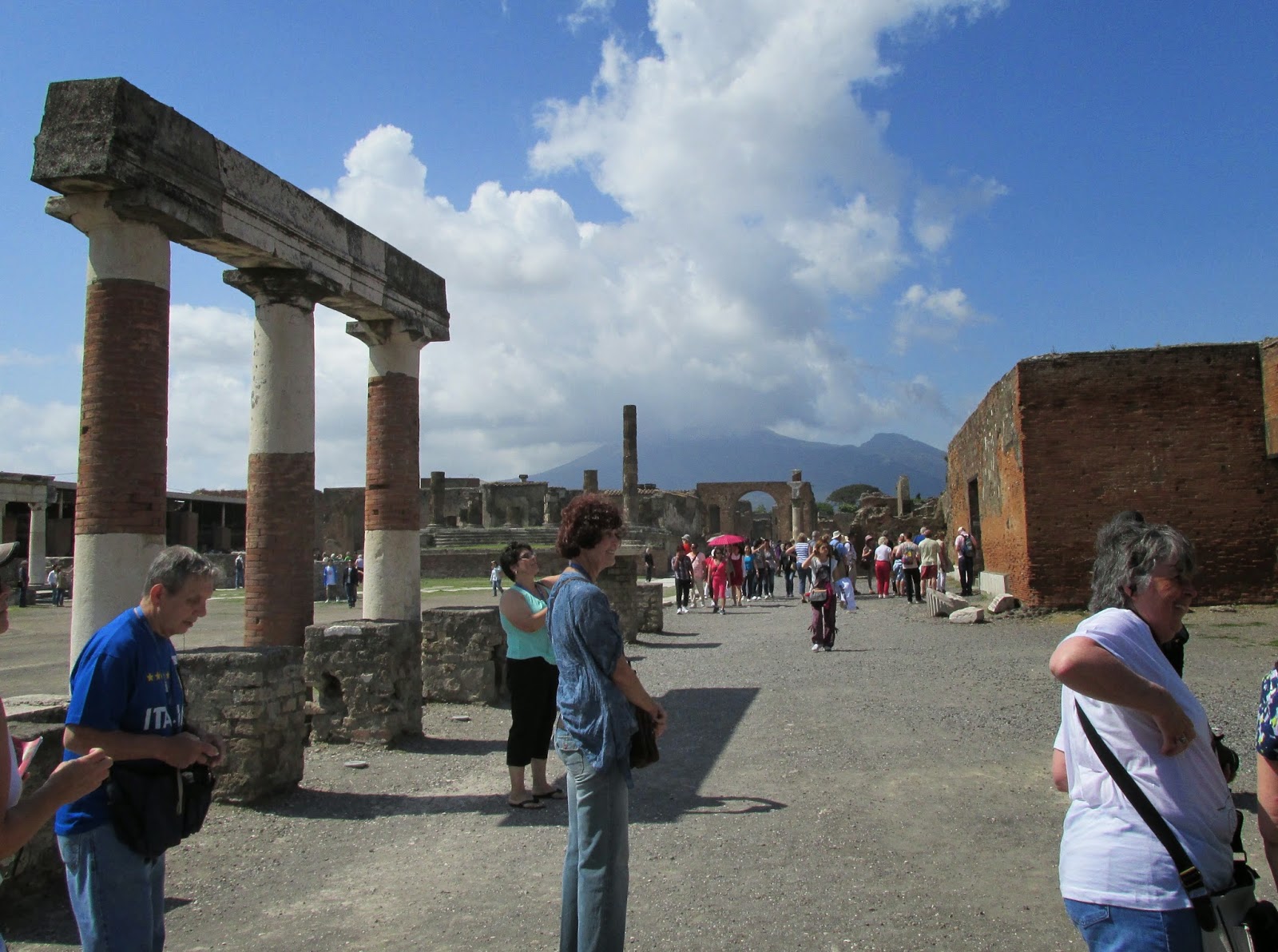
And the way almost everywhere you are, there is a view of the deadly mountain, seemingly not that close, but obviously close enough (it’s five miles away).

We went through one of the public baths, seeing several rooms, very cool and dim, whose names suggest what they were used for: the frigidarim -- no doubt especially appreciated on a hot summer’s day -- the tepidarium, the calidarium.  There had been colorful friezes on the walls; in some places you can just make out some faded color.  We were seeing just a small part of this bath -- it would have contained many more rooms -- changing rooms, the female side of the bath,  even rooms for gymnastics (a little exercise, before washing off the sweat with a bath).

Eventually we reached the forum, once the political, commercial and religious center of the city, now a large open grassy area -- which would have served as the marketplace -- surrounded by suggestions of the temples and public buildings that once stood there.  In one of these is to be seen a glass case containing the plaster cast of one of the carbonized victims of the disaster.  It is disturbing to look at the figure lying on its side, its face screwed up in agony, its hand reaching out.  It would be far worse if one were looking at the actual body.

Two hours is really not enough time to see all the places mentioned in ones guidebook -- as with so many other sites we visited I longed for more time -- but even this taste, this glimpse, made me happy.  I had seen one of the most unusual, fascinating places in the world.
The Forum, with Vesuvius, clouds like smoke, in background
 

Tuesday, August 6, 2013

The place with the big red dome

The famous Duomo (cathedral), which we visited after we left the Accademia Gallery, is first of all huge.  We came upon it from the side, and looking down its length, it seemed to go on forever.  It is even more magnificent on the outside than pictures of it suggest.  (The inside is less so, but more about that in a moment).  Particularly the façade: the multicolored marble – did I mention that everything in Italy seems to be made of marble? – is so striking, so different from the grey stone I was accustomed to seeing in French cathedrals.  When you’re standing looking up at it, it seems to be striped, but that’s a trick of the eye, caused by the long white marble panels trimmed in green marble.  These panels running up the sides, the front of the building, one atop the other, form green and white stripes. And there is also some rose-colored marble mixed in there, especially in the tall, square camponile (bell tower) that stands next to the church.

At the same time that you’re marveling at all that color, you are almost blinded by the whiteness of the vast central entrance, the two smaller arched entrances to either side.  And there are white niches containing sculptured figures on each side of the arches, and just below the roof. The large round windows above the pointed side arches, and the even larger window above the central arch, give a wonderful symmetry to the whole.   

Interestingly, though the church was built over a 140 year period (1296-1436), the marble facing on the façade (which is so gorgeous) was re-done in the late 1800s.  Can't help wondering what it looked like all those years. 

So I was busy snapping pictures, like everyone else, but oh, those crowds.  Losing one’s group was a real fear, and a real possibility.  At one point, when our guide was going on and on, as he had about David, I took the opportunity to sit down on a step of the church and finish the sandwich I had started eating when we were at the Palazzo Davanzati (as I’ve said, my need to eat frequently was a constant pain).  I heard the guide switch from the Duomo to the Baptistry, which is a few steps from the church, and is the place where babies in days of old had to be baptized before they could enter the church.  The most famous feature of this small, octagonal-shaped building are the double doors carved by the artist Ghiberti, over a 27-year period (these artistic masterpieces took a long time to produce!)  The doors are made up of 10 gilded panels beautifully carved with stories from the Old Testament. Most of us who took art history in college have studied these doors, and it was nice to be able to see them in the flesh, so to speak.  But as a matter of fact it was difficult to see them because of…you guessed it… the crowds.  Every picture I tried to take was obscured by heads, bodies, some group leader holding up a sign with a number on it so his group would know where he was.

I would have loved to be able to patiently wait until those pressed up against the gold-painted bars
Ghiberti's famous doors, completed 1452
that protect the doors from the hordes (and possible vandalism) had moved away, so that I could inch my way up to that barrier, and actually study the panels for a few minutes.  But alas, I was losing the guide’s voice – it was fading in and out on my little headphones (which I now had, thanks to Gianni coming equipped with a couple of spare ones) – and looking around, I couldn’t see a single member of my group.  Yikes!  Had they gone into the Baptistry?  I circled the place, searching for the entrance; when I finally found it, saw that there was a 5 Euro entrance fee.  No, surely they hadn’t gone in there.  So I returned to where I had started and there, praise the lord, was Gianni, looking around for me, waving when he saw me (and not for the last time). 

But wait, the group was moving off down the street.  I ran up to Gianni and exclaimed (literally exclaimed) “Gianni, we aren’t going into the Duomo?!”  No, he said, “There isn’t time.”  This absolutely flumoxed me.  How could you take people to see one of the most famous churches in the world, and not take them inside.  When I said this to Gianni he agreed with me, and said that when I got the email from Perillo asking how I had liked the tour, I should mention this.  “Because they won’t listen to us,” he said, meaning the guides. 

Alas, I never received such an email, never got the chance to voice my dismay at this egregious omission.  Perhaps if the guide hadn’t spent so much time on David, there would have been time.  Listen up, Perillo Tours.

I later went back by myself.  I was pleasantly surprised at how minimal the crowds were, how non-existent the line to get inside, and not for the first time I wondered, “Why do all the tour groups descend on these famous sites at the same time?”  Instead of everybody showing up  9-11 a.m., why don’t some of them go 2-4 p.m.?


Facade of Duomo, Florence
 

Side of Duomo, dome & a chapel in bkgrd
 At any rate, once inside I admit to finding myself mildly disappointed, as I had been with San Giorgio Maggiore in Venice.  Here, too, the word ‘austere’ probably sums it up best.  What you mainly notice about the place is that it is vast, vast and empty, no pews or chairs, practically no decoration, just great blank walls reaching up and up.  The few narrow stained glass windows are so high on those walls, they make practically no impression at all.  The one thing that is truly impressive is the inside of the great dome, which is as spectacular as the outside.  It’s so very high it’s hard to see the figures, the scenes clearly, but it is a wonderful swirl of rich color.  Worth going into the church…as long as there’s no line.

Thursday, July 4, 2013

Next Stop: Firenze

The countryside beyond Padua gradually became more hilly, and beyond Bologna, which we just drove past on the highway, the northern end of the Apennine Mountains, which run up the middle of the Italian boot, rose on our left.  These are friendly mountains, as opposed to majestic ones.  We were soon deep in the mountains’ lushly green foot hills, going up and down, and around curves.  In little valleys you could see farms, with their ocher-colored, red-tile-roofed  farmhouses.  And eventually the traffic slowed noticeably – ah, yes, the famous terrible Italian traffic, which we had not had to deal with up to now.

By the time we rolled into Florence it was raining, and coming on to evening, so Gianni made the decision to wait on the planned trip to Michelangelo Square, to view the city.  And we were glad he did, since instead we visited there on our last day, when it was partly sunny and dry; much better for viewing, and picture-taking.  We now went straight to our hotel, Grand Hotel Villa Medici.  Like the hotel in Venice this one was elegant and well-maintained, although more sleekly contemporary in its interior decoration.  There are “testimonials” in one of the lounge areas from famous folk like Luciano Pavarotti calling the hotel an “oasis” in the heart of Florence.   The beautifully landscaped swimming pool to be seen beyond large windows and modern French doors certainly looked like an oasis; indeed, I regretted that we simply did not have the time to sit out there and relax for an hour or so.  (See Note of May 18, 2013)
Grand Hotel Villa Medici

The most disconcerting aspect of the hotel was the way the main elevator kept going on the fritz.  There was another elevator, just across the lobby from the main one, but it came out in a place that left you confused as to where you were.  And we never knew when the elevator would be out of commission, so everybody spent a lot of time wandering around upstairs, trying to figure out which elevator to take.

The best thing about the hotel was that our room, while considerably smaller than the room in Venice, had a balcony.  Pat especially appreciated this feature, since she could smoke without having to go downstairs and outside.  And I delighted in looking over the waist-high wall and watching the life on a Florence street: people going in and out of the small shops, the apartment buildings, the light traffic on the street: buzzing motor scooters, the small cars, the occasional tourist bus.  I discovered, when I went out looking for food later, that down a couple of blocks to the left there were numerous hotels and small restaurants, as well as a mini-mart that was able to supply me with my standby ham-and-cheese sandwiches (and was staffed by someone of obvious mid-eastern ancestry: shades of New York/Boston/ and many other large cities).  And we watched an absolutely gorgeous sunset from that balcony, while listening to swooping, whistling birds, that someone told us were swallows.
Sunset from our balcony

The next day we began our touring by visiting the Palazzo Davanzati, one of the few residential buildings in Florence dating from the medieval period.  We tend to have a Cinderella-ish idea of what a palace is, but among the Italians of old a palazzo could be simply, as this building was, the large home of a rich family.   From the front it is unprepossessing: a very flat – no protruding balconies, shutters, or even window sills – plain, brown building, four stories high.  Our guide pointed out that something the façade did have were iron sconces, to hold torches, and flags.  Medieval Italian city states, like Florence, were torn by internal factions, often a matter of guilds, who had their own flags.   Whatever group you belonged to, you flew their flag.  Even today, flag waving is very big in Italy.

There are also lots of iron hooks, curved upwards, called erri.  These were used to hang baskets of flowers from, or banners, on festive days, or to leash little pet dogs or moneys.  So presumably the façade was often much less drab than it appears today.

Inside, I immediately felt I had stepped back into Romeo and Juliet’s day.  The ground floor is actually a stone-floored courtyard, though it seems less like one now, because there is a roof four floors above, rather than the awning that would originally have been there, which could be rolled back to let in air, or rolled into place to keep out rain.  The wide double doors leading out to the street would have been left open during the day, and people would have entered and left at will.  Off this courtyard is, among other rooms, the room where banking transactions would have taken place, for the Davizzis, who built the house in the early 1300s , were wealthy merchants and bankers.  There is a stone stairway leading up to the first floor, where the family’s private rooms were located.  Halfway up this staircase is a heavy door, that would have been manned by a guard, to keep out the riff-raff.

Upstairs, on each floor, a gallery runs around three sides of the house, and looks down on the courtyard.  I could just imagine the young girls of the house, peering over the stone balustrade at some dashing young fellow in striped tights below.  The rooms open off of this galley – the Great Hall, where special guests would have been entertained, bedrooms – one of which had been painted to look like the walls are covered with beautiful tiles, the other of which seems to have beautiful fabric wall hangings, also painted on.  There’s even a toilet.  In most of the rooms a few beautiful, elaborately carved wooden chairs, tables, chests.  I saw why there were no shutters to be seen on the outside of the building – the heavy wooden shutters are inside, and fold up accordion fashion when you open them.
 
I loved the place.  Pat hated all the stone stairs.
Beautifully decorated building in Florence


Sunday, June 23, 2013

God's House

I am not a religious person, but I love churches. That is, I love beautiful churches, not the bare, unadorned churches (often Baptist) of my native South, and elsewhere. I love them because of their beauty, and because of the peacefulness they exhibit (when they’re not crowded with tourists) and the contemplation they can encourage (when they’re not crowded with tourists). On the drive to Florence we stopped in the university town of Padua, and saw a sublimely beautiful church, the Basilica of St. Anthony.

First we had to get there. On Wednesday, we were taken by several boats back to the mainland where we climbed aboard a huge bus. It was comfortable, but we had been told (in the literature we were sent) that it would have a restroom on board; and for the longest time most of us didn’t realize there really was a restroom, because it was tucked down beneath the row of seats that was just before the back door. The bus was so high, that you had to walk down several steps to get to the back door, and most of us failed to notice the door built into the wall on the left of the “stairwell.” Eventually the assertive Bonnie, who had to go the bathroom almost as often as I did, and was not shy about letting people know it, discovered the toilette – which is what it is called, none of those euphemisms like restroom, or bathroom, or ladies/men’s room – and took the plunge to use it. “I don’t care, I had to go,” she announced when she came out.

For the longest time I was leery of using it, fearing it would be one of the “squat” kind, that used to be much more prevalent in Europe than they are now, but that you can still happen upon. Frankly, I didn’t see how you would be able to stand up in what seemed like very little space beneath the seats above. But finally the body won out and I went…only to discover that it was a perfectly nice, very clean little “restroom” that you could certainly stand up in. There was even a sink where you could wash your hands. After that, the toilette on board and I were good friends.

The countryside between Venice and Padua (which is Padova to the Italians) is flat farmland, with the occasional hill, the occasional clump of trees. I noticed that virtually all the small farms had their own little vineyard – everybody grows grapes.

At Padua, in the huge bus parking lot, we noticed scattered about some rather disreputable looking people, and Gianni announced over his little intercom that they were gypsies, and we must take care not to encourage them. He said this more than once, which immediately had me feeling sorry for these people – who included women and children – and who were so obviously treated as pariahs. But I didn’t encourage them: beggars, or people selling cheap junk instead of begging, may tug at my heartstrings, but I don’t allow myself to be drawn into their net.


Canal of Prato della Valle (professional photo)

It was a good long walk to the church, through what I thought at the time was just a large open park, but which I later learned was the Prato della Valle, the largest public square in Europe. It has a canal running through it, and large statues up on pedestals all around. It also has young black men selling the cutest little windup toys, unusual things, like roosters and old-fashioned cars. I was much more tempted by these, than I had been by the handbags in Venice, and if I’d had some little nephew back home, I might very well have stopped and asked the price.

I did dash into a store at one point to buy a water – praying that the briskly walking tour would not get too far ahead of me -- because I had finished off the bottle I had, and was always thirsty (which undoubtedly contributed to all the bathroom runs). It cost only 1 Euro, but the packaging proved to be quite inferior. When I tried to unscrew the lid, the whole top came off, which meant I couldn’t screw the lid back on. And the plastic was very soft, so that the bottle squished, and putting it in my shoulder bag resulted in water everywhere. Later I did get another bottle, hoping it would be made of firmer stuff. It was just as squishy, but I had Pat unscrew the lid – she proved to have a lighter touch – and I was at least able to keep the bottle in my bag without getting everything wet. After that, Pat opened all my bottles of water.


Basilica of Saint Anthony (professional photo)

On the open plaza before the basilica Gianni informed us that the squat toilets could be found to the left, the “normal” toilets off the cloister to the right, and let us go, for 45 minutes. I and a bunch of other people made a beeline for the normal toilets – where we had to pay a Euro to get through the turnstyle, and where there was a man on permanent clean-up duty in the ladies’ room, which is actually not that unusual. Bodily functions taken care of, I went into the church, and was blown away.

Absolutely gorgeous. The tomb of St. Anthony sits on a dias on the left, surrounded by a semi-circle of beautifully executed wall sculptures, of blindingly white marble, representing different events in the saint’s life. I recall looking at the famous “The Miracle of the Reattached Foot,” without it registering that the young man did not, indeed, have a foot. The back of the saint’s sarcophagus, which you pass as you are walking the semi-circle, is a place where many people stop, press their hand against the marble, and say a prayer. A few in our group did this. (I was later to realize that quite a number of the PT group were good Catholics, who, for example, were very excited about being able to see the new pope when we were in Rome). We couldn’t stand directly in front of the saint’s tomb, because it was roped off, as there was a service going on in the nave in front of it (which I thought odd – how distracting to be trying to sing the Lord’s praises while all these people were moving about, even talking, to either side of you) but you could see from the side that it is of a beautiful green marble – in Italy there is simply marble, marble everywhere – and was surrounded by mounds of flowers.

As you continue past the tomb you come into what is known as the Chapel of the Black Madonna. I didn’t know this at the time, but I was looking right at the Black Madonna, who wasn’t black at all, but quite white. One of life’s mysteries. This chapel is actually the original church, which existed in St. Anthony’s time (early 1200s), and around which the rest of the basilica was built.

Behind this chapel there is a larger, and very beautiful, chapel that is simply covered with frescos in the late medieval style (late 1300s). You could tell that the paintings were beautiful – lots of gold mixed in with the rich colors -- but you couldn’t see them very clearly, because the chapel was dimly lit, and many of the paintings were high, on the arched ceiling, indeed, on the inside of the arches themselves. I told Pat it probably looked better when they got bright lights in there to take a picture, and as a matter of fact, when I later picked up a free guide from a stereotypically kindly looking old monk, I found a picture of the chapel in which they had obviously done exactly that. This, by the way, was the Chapel of Blessed Luke Belludi, who was one of Anthony’s buddies.

The chapel that really took my breath away was the Chapel of the Relics, or the Treasury Chapel. Like all good Catholic churches in Europe, this one has holy “relics,” in this case a couple of bone fragments, a fragment of skin (uggh), and some hair from St. Anthony, as well as the biggest deal of all, his “uncorrupted tongue.” There is also, of course, a piece of the True Cross. Every major church has a piece of the True Cross. The Protestant reformer John Calvin once remarked that there were enough pieces of the True Cross to build a ship.

Pat was absolutely fascinated by the idea of seeing the “uncorrupted” tongue of someone who had died in 1231, so got in line to make the pass before the three marble niches that contain the three gold reliquaries. Since I am not really interested in seeing anybody’s tongue, whatever shape it is in, I contented myself with staring up and around at this gorgeous room, with the red-streaked-with-grey marble walls of the reliquary area, the elaborate, Baroque statuary, in big frames, as if they were pictures, high on the walls, as well as above the reliquary niches, along the marble balustrade that separated the reliquary area from the rest of the room.

Unlike many of the churches I saw in Italy, this one was full of color, and many beautiful frescos that were more in the style I like – that of the late medieval period – than the overblown style of the famous painters of the 1500s. And the cloister I visited later (I have a thing about cloisters), while less peaceful than it should have been, thanks to all the tourists, was still lovely, with its huge magnolia tree in the center. And the smaller cloister beyond, which most of the tourists hadn’t discovered, really was peaceful, with the only sound being birdsong. For a while I sat enjoying that, then gradually realized that it was sounding very repetitive. And I couldn’t see any birds, but I did see speakers, tucked away in corners. Recorded birdsong. Ah, well…

Monday, June 17, 2013

From the unfortunate to the sublime

O.K., so I missed the walking tour of the Basilica, the Doge’s Palace, and the prison behind it.  I was disappointed, but not crushed, especially after Pat collapsed into the room, after what had been a very long day for her, and informed me that the guide, who was “very knowledgeable,” gave them detailed information on every picture hanging on every wall.  I would soon have been  swooning with boredom.  I like a little history with my tours, but not so much that I can’t properly assimilate it.  I figure I can always read up on the history of this that or the other person/political situation/work of art if I’m sufficiently interested.  But to be force-fed bushels of information while I’m trying to take in, visually, whatever we’re passing: no, not for me.  I was to feel the same way when we visited the Accademia Gallery in Florence, and the local guide spent 45 minutes talking about the sculpture of David (after spending 15 minutes on the unfinished Slaves, which stand in the gallery that leads to David) .  Mind you, David is indeed an incredible work of art – and speaking strictly as a woman, if the guy also had a brain and a sense of humor, he’d make a really good Significant Other – but 45 minutes is definitely overkill, for people who are not art students.  While the others in the group remained politely in thrall to the guide, I wandered off and got to see three different, fascinating parts of the museum, which the others missed because when the David talk ended, we were hustled out to the gift shop, and that was that.

But to return to Venice:  what did I do instead of the walking tour?  Exactly what I had wanted to do that morning: explore.  First I grabbed another sandwich from a little place on the Street of Sandwich Makers (actually Calle de le Rasse) recommended by the irreplaceable Rick Steves.  I went to the same place I had gone to the evening before when getting a sandwich for Pat – I hope this eases the minds of those of you who thought I had completely forgotten about my friend while enjoying my dinner out -- and one for me, for later, when I would inevitable be hungry again.  I was hoping the same pretty, sweet-smiling young man would be there, but alas, this time it was an old man and his wife.  I whipped out one of the few Italian phrases I’d had the opportunity to use since coming to Italy – Un panino al fromaggio e prosciutto, per favore – and the old man took one of those waiting in the display case and plopped it into the waffle-iron-like toaster.  I also ordered “un Coca-Cola Lite” which I had learned, as in France, was the way to get a Diet Coke.  Then I moved as fast as I could, through the narrow passages that led out to that vast San Marco Square, which I had to get across, all the time painfully aware of how desperately I needed to use the bathroom (had needed to go since my second trip to San Giorgio, but I was damned if I would use that paperless toilet again), and there were still a few blocks to go beyond the square.   I was never so glad to see anyplace as the Hotel Europa & Regina, and made a second-base dive for the elegant restroom off the Reception area, rather than try to make it up to our room.

Anyway, after a rest of about an hour, and another rejuvenating bath, I set out on my walk.  Followed the flow of tourists down Calle Larga, around corners, along more narrow alley-like streets lined with shops and small hotels, which I was glad I wasn’t staying in. since they would undoubtedly be noisy, right over the street as they were.  Was enchanted when I paused at a very small bridge crossing a very narrow canal, and a glance to the left showed me a woman walking briskly along the narrow walkway to her back door.  Frequently at a bridge you find these walkways, usually running just a short way down the canal; when they end, it is just buildings, with the water lapping at them.

 Finally came out into the small square with a big name, Campo Santa Maria Zobenigo. The little church of the same name had signs out front advertising a display of Vivaldi-era music and instruments, so I went inside and spent a few minutes gazing at exquisitely beautiful violins and mandolins from the 1600s, the 1700s.  There was also a sign advertising a concert that night that would include Vivaldi’s Four Seasons.  Oh, my god, a chance to hear one of my favorite pieces in the city where it was written.  But alas, the church where the concert was to be held was not this church, and I had no idea where la chiesa di San Vidal was located.  However, I kept walking, eventually reaching a much larger square (like many “squares” it’s actually a rectangle) and at the far end of it what should I find but…the church of San Vidal.  I went inside and asked if there might possibly be any tickets left, were I to show up there at nine o’clock that night.  The woman said yes. “Not a large group, no, but one person, I think, yes.”  Hmmm…

I kept walking, across the nearby Accademia Bridge – from which I took the two pictures in an earlier posting – past the Accademia Gallery, and deep into the area called Dorsoduro.  And here I was able to see regular folks walking into their regular apartment buildings, regular old folks sitting in virtually deserted squares; I was able to get the smallest glimpse of “real” Venice.  I noticed a number of roof gardens, and greenery tumbling over walls – people will try to put a little green into their lives, wherever they may live.
Residential Street in Venice


Accademia Bridge

That evening, I did go with the group to the restaurant where we were to be treated to dinner.  But I took the fact that it was at the other end of Campo Santa Maria Zobenigo – a mere brisk eight minute walk from the church of San Vidal – as a significant, and rather exciting, sign.  And at ten of nine, after plowing my way through the appetizer, much too much pasta (which was usually the case), and an insipid salad, I made the decision.  I slipped away, made the brisk walk to the church, got one of the last seats in the place (at the reduco price of 21 Euros – absolutely the only positive aspect to creeping old age is senior discounts), and spent one of the most sublime hours of my trip, listening to Vivaldi – Venice’s favorite native son -- in a place, and fashion, that could have seen just such a concert in Vivaldi’s time.  The group playing, Interpreti Venziani, played with power, even exuberance (indeed, the cello player, who was very good, was also hard to watch, because he seemed to be having mini-seizures of ecstasy). 

What can I say, I was completely, completely happy.

Sunday, June 2, 2013

Our night on the town

When you step out the official “front” door of Hotel Europa & Regina, you’re in a courtyard completely surrounded by buildings, all maybe three of four stories high. If you walk to the far corner of the courtyard, you find that there is a little passage between buildings. You follow it around a couple of corners, and out to where there is a “nest” of gondolas, young men lounging in them, waiting for customers. They are gathered at one of the little stone bridges that crosses the smaller canals.

If you turn left at the bridge you are on Calle Larga, a relatively wide, pedestrians-only street, (but note that Calle means ‘narrow street’) lined with shops, and including two banks, both of which have ATMs that got heavy use from the Perillo Tours (PT) group. At the ATMs you do have to make a point of switching languages, as I was later informed by Patricia, who had failed to do so (didn’t notice the button where you could do that), and so was trying to fumble her way through obtaining money, in Italian.

The other thing that Calle Larga has is a number of very black young men with clutches of large, fancy handbags – knockoffs of famous-brand names, I later learned – that they are hawking. You actually see these guys everywhere, and I couldn’t help wondering if they were some of the thousands of Africans who have fled to Italy over the past few years. Later learned that they are exactly that, and that the police vacillate between harassing them, for harassing the tourists, and turning a blind eye. It certainly is important to just keep walking when they approach you, not make eye contact, etc., not because they’re dangerous, but because otherwise they won’t leave you alone. I admit to feeling sorry for them, thinking what a wretched way to try to make a living this was, but I reckon it’s better than begging.


San Moise, with tourists
If you turn right at the little stone bridge, what you’re looking at is the very small, incredibly ornate church of San Moise (and who, I wondered, was Saint Moise?), sitting in its own little Campo, or Square. This was the first of many, many churches I was to encounter in Italy, and easily sported the greatest amount of elaborate carving. It almost seemed like a toy church, sitting in its little toy square.  A couple of blocks down the calle that starts beside the church, and continues past shop after shop selling (in particular) leather handbags, sometimes outrageous shoes, and sleek, elegant, no doubt wildly expensive clothes, you finally pass through an archway, and are looking out at famous San Marco Square.

Yes, it is huge. The size, along with all those columns marching down either side, supporting the arches that support the buildings, made me think of a military parade ground. We were seeing it at the perfect time: twilight when the thousands of tourists had departed, either back to their cruise ships, or their cheaper housing on the mainland, or just back to their hotel to rest and get ready for dinner. There were still people in the square, feeding the pigeons (lots of pigeons), taking pictures, and just strolling, that famous Italian pastime. Most of the cafes that line the square have live music of an evening: one of them was already in full voice, playing chamber music to a bunch of thus-far empty chairs and tables.

San Marco Square
My first impression of the Basilica of San Marco, at the opposite end of the square, was that it was rather squat, compared to all the soaring Gothic cathedrals I’ve seen in England and France. And all those domes, with their onion tops – the giant center one, the two handmaidens – as well as all the fat, almost dome-like arches that serve as entrances, and the fat, curved dormers that march along the front balcony – it all gives an exotic, Eastern look to the place. Naturally, as Fate would have it, there was scaffolding covering half of the façade, a photo ruiner if there ever was one. But I took a picture anyway.

Basilica of San Marco, Camponile on the right

 Our little group made its way under the “big clock” per Gianni’s instructions, and found ourselves in a narrow lane crowded with tiny shops selling carnival masks, sandwiches, gelato, and every kind of souvenir you could imagine. I seemed to be the only one who recalled Gianni saying we should “turn left” at some point. A glance down the first left didn’t produce anything promising, but at the end of the lane, where you had to turn either left or right, a glance to the left, just across a tiny bridge that spanned a tiny canal, was a tiny ristorante, Anima Bella. We’d found it!!

And it turned out to be perfect. Two good-natured, very Italian women working culinary miracles behind a half wall. They saved us a lot of time and confusion by announcing briskly that there was “only pasta,” and then giving us a choice of kind. This made dinner a far less painstaking affair than other dinners we were to have. For example, the following evening, when we were treated to dinner by PT, it took almost three hours to plough our way through all the separate courses -- appetizer, pasta, salad, main course, desert. This is far too long a time for me to maintain my interest, and involves far too much food. (And the food was mediocre, to boot!)

But here at Anima Bella the pasta with seafood that I ordered was excellent (the seafood turned out be to large shrimp, complete with legs and exoskeleton -- dining in Greece had taught me to expect this – you do not get denuded shrimp); the three ladies who ordered tortellini declared it superb; Bud, the all-but-silent husband of the much more voluble Bonnie, couldn’t decide, and was finally talked into “pasta with sausage and sweet peppers,” which turned out to be, basically, our spaghetti with meat sauce. He utterly cleaned his plate, and declared it “not bad.” And Walt, the oldest member of the PT group, a sweet, funny man, was the only one who went off the grid, and ordered antipasto, which produced a marvelous array of cold cuts, olives and cheese.

This was certainly one of the more enjoyable experiences of the trip, a cheerful, getting-to-know-one-another stroll to the restaurant, with a first, very impressive view of San Marco Square along the way, then a tasty dinner, pleasantly lubricated with just the right amount of wine, plenty of conversation, and laughter. Can’t beat that.


Monday, May 27, 2013

Hotel Paradiso

Our hotel in Venice was a lovely old hotel, very much first class, with shiny marble floors of dark and light geometric patterns, beautiful chandeliers, marble trimming the arched doorways, art deco stained glass in the transoms above.  I can speak only of our room, but it was large, clean, comfortable, with elegant, old-style furniture, and a big, marble-floored bathroom.  And we had a view of the canal, from our two windows, though it was not a straight-on view, since most of the rooms in the hotel face each other across the space that separates what were once two separate 17th century “palaces” (i.e., rich people’s fancy homes), now connected by one of the restaurant’s dining rooms, with the hotel’s tiny terrace in front of it – these are what lay directly beneath our windows – and, at the back of the building, by a narrow, black-and-white-check-floored corridor, which was what everyone took to get from their rooms to the main part of the hotel.

Unfortunately, when Pat and I arrived at Hotel Westin Europa & Regina there was no room available for us.  The hotel was currently filled to overflowing with what seemed like hundreds of folks from (as we later ascertained) a cruise ship, very noisy and chaotic.  They were obviously in the process of checking out – their suitcases were all crowded together at one side of the main hallway that led from the door to the dock to Reception, at what was officially the front of the hotel, but seemed like the back – but in the meantime their rooms were still being cleaned.  The woman at the desk was also confused because, as she said, the people with Perillo Tours (PT) usually all came together.  If we would please to wait until the others came…

Which takes me to the big snafu that put the other members of the tour in a rather sour mood right at the outset.  Gianni, our PT guide (and that is his real name), had made the decision to wait for everyone who was coming in, even though they were arriving at different times.  Thus, he met the folks whose plane arrived at 9:30, and asked if they would please be so patient as to wait for us.  He knew that our plane was late, and informed the group – who of course were all as tired as Pat and I.  So they all waited, not only past 11, but past 12, until 1 p.m., when Gianni finally gave up, mainly because Kelly, the woman from Kentucky, kept insisting that she was pretty sure, given our conversation while we were waiting for our luggage, that we had already left.

This error in judgment is probably the only negative thing I can put to Gianni.  For about 12 hours a day, for eight days, he was trying to keep track of 36 rowdy Americans, some of them determinedly independent (I plead guilty – he was always having to look around for/wait for, me), and he was invariably patient and good-natured.  But the idea of keeping over 20 tired people waiting for up to three hours, for two other people, seems really preposterous.  I assume it was to prevent his having to go back to the airport, but still…

Meanwhile, back at the ranch, I had to be fed, and Pat had to have a cigarette.  My hypoglycemia, which requires that I ingest a reasonable amount of protein every three hours, was as inconvenient as it always is when I travel.   While Pat joined the cruise folk out on the terrace, I ventured into the dimly-lit bar with its elegant bar of dark brown and charcoal grey Italian marble, and little tables scattered about.  For some time, I sat at a little table just inside the door, feeling vaguely uneasy and unsure of myself,  until the male half of the barkeeping team took note of me.  When I asked if I could get something to eat, he said of course, then took forever to bring me a menu.  I carefully avoided looking aghast when I saw the prices: a Ceasar Salad with chicken for 23 Euros ($33), a hamburger, which I certainly wouldn’t have wanted to be ordering in Italy anyway, was 24 Euros.  There was nothing on the menu I could bring myself to spend so much money on, and I suspected it would take forever to get my food anyway.  So I went back out into the main hallway, which I suppose I should call the lobby.  In the dining room across the way there was obviously an “event” going on.  I wafted through, on my way out to the terrace, and saw that it was a cold buffet.  Hmmm…

Given all the people milling around, I decided to take a chance on blending in, grabbed a plate, and started picking and choosing.  All the silverware to be seen was in the place-settings on the tables around the room, where people were sitting, laughing and talking, so I ended up eating everything with my fingers, but that was o.k.  When I joined Pat on the terrace, where she had managed to snag one of the few chairs at one of the glass-topped tables, I had a nice collection of odds and ends, most of which were delicious, including the perfectly ripe, and sweet, strawberries, and kiwi.  Throughout the trip we were treated to fresh, ripe fruit at the breakfasts provided by our hotels, and it was such a joy, especially for this person from Maine. Most of the fruit we get is rock hard, as it has been picked well before having ripened, in order to ship it safely.


Santa Maria della Salute from hotel terrace

The half hour or so that we spent sitting on that terrace was among those moments I stated earlier we didn’t have enough of: time to just sit and take in the realness of where we were. The ornate, domed church Santa Maria della Salute lay directly across the canal.  We watched boats gliding by in the canal, in particular an extraordinary number of gondolas, sometimes with the young gondoliers singing their hearts out as they poled away.  Once a group of three lined up side-by-side, and gave a joint performance.  What made this seem especially strange was that what one thinks of as a romantic experience was taking place in the middle of the day.  Pat and I agreed it was all rather hokey – very much in the theme park vein – and we agreed we weren’t going to fork up the 42 Euros apiece to go on the optional gondola ride the following evening.   (Note: most of the folks who did go on it seemed to enjoy it enormously.)

The hundreds of jolly cruise folk decamped at last, taking with them the resort air they had foisted on the place, and almost immediately thereafter the PT group arrived.  Gianni greeted Pat and me with unmitigated joy – he had not lost two of his travelers on the very first day – and went to get us all registered.  Unfortunately, our rooms still weren’t ready, and wouldn’t be until about 3:30.  Some energetic folks took off to explore the neighborhood; Pat and I (and a number of other people) were just too tired.  Some collapsed into the elegant chairs and sofas in the lobby, and fussed with their electronic devices; I forked up 12 Euros for a coffee from the bar, and Pat and I sustained ourselves with that, and some pieces of chocolate she had tucked away in her purse. 


View from our room
When we did, finally, get our rooms, Pat collapsed onto the bed and announced she was done for the day.  I rested for a while, took a stimulating hot bath in the wonderfully long, old-fashioned bathtub – what a luxurious joy to be able to stretch out completely – got dressed, and set out to find one of the sandwich places mentioned in Rick Steve’s Italy.  I was going to get something for me, for now, and something for Pat, for when she came to.  But down in the lobby I met a group of people who were planning on making their way to a ristorante that had been recommended by Gianni.  I asked if I could join them and they said sure, the more the merrier. 

But that’s our next adventure.

Saturday, May 25, 2013

Venezia

Venice was enchanting.  I’d live there in a heartbeat. No traffic!  I personally consider the automobile the scourge of modern-day urban living, and here is a city without the automobile! 

I have a thing about islands anyway, as evidenced by my having spent six weeks living on Santorini, three months on the Ile d’Yeu, off the west coast of France, and on the Isle of Mull, off the west coast of Scotland.  For that matter, would love to be able to live on one of the many islands off the coast of Maine.  What’s different about Venice, as compared with all those other, and most other, islands, is that it is all one city.  Although really that city is made up of not just one island, but a total of 100 tiny islands.  Every time you cross one of the many, many little, and several large, bridges, you are crossing from one island to another.  There are also several larger islands in the lagoon, that are also visited by tourists: Murano, famous for its glassblowers, Burano, ditto for its lace,  Torcello, which served as the original settlement of Italians seeking refuge from the barbarian invasions of the 5th and 6th centuries, and now is virtually deserted, and San Giorgio Maggiore, directly across the lagoon from San Marco Square, and famous for the view to be had from the bell tower of its cool, peaceful church.

But let’s take it from my first view of the city, when Pat and I took an incredibly expensive (110 Euros, or about $143!) water taxi from the airport, which is on the mainland, to our hotel.  We were supposed to be provided with free transport by Perillo Tours (PT), if we were around at the 9 a.m., 11 a.m. or 1 p.m. transport times.  According to the instruction sheet we had received from PT, if we missed these pick-up times, it was up to us to get ourselves to the hotel.  Well, our connecting flight from Rome to Venice was late, setting down at 11, so obviously we had missed that pick-up time.  By the time we got our luggage it was close to 12.  We were both very tired from our sleepless overnight flight from Boston, and I saw no point in our hanging around the airport for an hour, just for a free ride.  While waiting for our baggage to show up I had spoken briefly with the female half of the only other Perillo couple we had thus far encountered, wanting to know if they would be interested in sharing a water taxi.  “Kelly” (red-haired, sassy, works as a physician’s assistant; she and her husband look about 25, but have been married 10 years with two kids so are presumably closer to 30) said they’d probably wait for the tour pick-up.  By the time the bags appeared she had disappeared, so Patricia and I  made our way out to the counter where you could purchase tickets for the water taxis.

Later I had to acknowledge that it was a shame we had lost track of the young couple from Kentucky, since that steep fare covered up to four people.  Splitting that $143 would have been nice.   But I also have to admit that, at the time, I really didn’t care.  I loved the very idea of taking a boat from the airport to the door of my hotel, loved the swift, sometimes thump/thump/THUMP careening through the water, the cool air on my face (it was a pale gray day; rain was forecast), a polite, brawny young man at the wheel, boats speeding past, going the other way, or trailing out ahead of us, behind us – a regular highway of boat traffic.  And gradually, as we moved down the wide lagoon, Venice proper took shape before us.  No tall buildings – only the tall, narrow, bell towers at San Marco Square, and San Giorgio Maggiore – but rather cheek-by-jowl buildings of four or five stories, mostly beige, pale yellow, light brown, but also pink, a brighter yellow, even aqua.  As our driver slowed the boat and we turned into a canal, we were passing just a few feet on either side from these buildings – people’s homes! – with the water lapping at the walls, slopping over the tiny step to be seen at some back doors. We glided under low stone bridges that curved above our heads, and finally turned out into what I knew must be the Grand Canal.  The buildings on either side were much grander than those we had seen in the “side” canal, often with a large centered balcony on an upper floor, where the family back in the good ol’ days (1600s, 1700s) could have gathered to watch whatever to-do was taking place on the canal.

Which was currently full of boat traffic – besides the little speed boats like ours (would hold six comfortably in the little covered “cabin” where Pat and I sat), there were the long white vaporetti , or public buses, an astounding number of gondolas, being steered by the young men in their black and white striped shirts, and a number of what I came to think of as truck boats, i.e, boats transporting goods that would ordinarily be transported by truck.  For example, on the morning we left, we watched from the small terrace of our hotel as a winch was used to lift bins of the hotel’s dirty linen from the dock into a boat, obviously to be taken off to be cleaned.  
Grand Canal from the Accademia Bridge


Looking in the other direction


There were tourists everywhere – in the boats, filling the small terraces of the cafes that fronted the canal, crowded onto the famous Rialto Bridge, that we passed under, then the rather odd Accademia Bridge, which looks like a graduate student’s geometric project, surging along the occasional narrow walkways that ran beside the canal for a short distance.  I couldn’t help exclaiming at one point, “It looks like a theme park!”  Because it was so unreal, that this could be a real place – and it was packed with tourists!

Finally, exactly at the point where the Grand Canal opens out into the lagoon, we pulled up to the dock of the Westin Hotel Europa e Regina.  We had reached our first home-away-from-home.  

Saturday, May 18, 2013

It's Tuesday, This Must be Belgium, or, Melody's Whirlwind Trip to Italy

O.K., there are positives and negatives attached to almost everything; perfection awaits us in another life.  So let’s get the negative stuff out of the way first.  The most negative aspect of my long-awaited trip to Italy was that I and my friend Pat were fighting exhaustion virtually the entire time.  The tour we were on – Perillo Tours’ Marco Polo, for the record -- was grueling, probably more appropriate for people twenty years younger than we, people with more energy at their command, and certainly more stamina.  Our group of 36 included a few in that category, though it seemed to me that most of the folks were somewhere in their 50s.  Pat and I, with our 1947 birth year, were probably among the oldest of the “couples,” (as all but three women traveling alone were).  One lady was 78, and her husband was probably a couple of years older; they proved themselves amazingly resilient.  But poor Patricia, with her carefully controlled leukemia, and me with my never-very-high energy level, were anything but. 

Patricia, as a retired lady of leisure, is accustomed to getting up about 9, feeding the dog, having a cup of coffee & a cigarette while she reads the paper (and her smoking was moderately problematic throughout the trip, as none of the hotels permitted it), having a breakfast pastry and another cup of coffee before taking a shower, and finally being ready to tackle the world about 12.  Although I am still a working stiff, I, too, am accustomed to fairly leisurely mornings, since I don’t usually have to be to work until 11; virtually never get up before 8.  But here we were, dragging ourselves out of bed with the 6:30 wake-up calls, on the bus by 8 a.m., doing a lot of walking when the bus got us to wherever we were going, being given a lunch break of an hour to an hour and a half, with no additional time for resting, before we did it all again for the afternoon’s excursion.   I’m accustomed to resting frequently, usually take a nap after returning from my 4  1/2 to 6 hour work days.  But on our tour the only way to get some rest was to say no to some activity or other, which as a matter of fact we did, twice.  In Florence we did not go to one of the free dinners, because Pat was utterly dead from the day’s activities, and I couldn’t bring myself to abandon her for the evening (naturally it was the dinner that everyone said was the best of the three we’d so far been provided with).  And ultimately I opted out of the final afternoon excursion, in Rome, because I knew I simply had to rest.  After doing so for a couple of hours, I was able to go out for a walk, to the famous Spanish Steps, about 15 minutes from our hotel, and also to the nearby Trevi Fountain.  I was still back at the hotel well before the exhausted excursion folks returned.

While Pat and I may have been especially hard-hit by the rigors of the tour, they were hard on everyone.  Diana (names have been changed to protect the innocent), one of the ladies who was making the tour on her own, said at lunch on the next to the last day, “I am so tired of being tired.”  And all of us at her table laughed uproariously in rueful agreement.

The other major negative, as far as I (and I think a number of other people) was concerned, was that there was insufficient time allotted to be able to just enjoy the sights we were seeing.  Except for the church we visited in Padua, we always had a local guide, giving us historical facts in heavily accented English, through the little earphone sets we were given.  So there you were, marching along, trying to catch what was being said, at the same time that you were trying to take in all that you were seeing.  And naturally at times something just cried out to be photographed.  Now, admittedly, those folks with smart phones were at an advantage when it came to taking pictures.  They could just point the phone at the desired image, shoot, and keep on walking.  Some of us had slightly more demanding cameras, and mine was especially demanding, as it was new, and I really didn’t know how to work the damn thing properly.  Time and again the group would have moved on, while I was still trying to get a shot – sometimes impeded by people from other groups (there were a kazillion tour groups, which is actually another negative, but one that Perillo Tours can hardly be held responsible for), and I would then have to go hurrying up the hill, or down the street, or through the church, trying to relocate them.

And sometimes it wasn’t even a matter of wanting to take a picture, but of just wanting to be able to sit and enjoy the scenery for a while, luxuriate in the realness of actually being where you were – hey, dig this: I’m in Venice/Florence/Siena -- or to go off and explore on your own for maybe an hour. One of the few opportunities we had for this sort of thing was on the morning we left Florence for Rome.  We drove first to Michaelangelo Square, with a glorious view of the city spread out below us, the hills in the background.  We were able to spend a relaxing half hour drinking in the view, taking pictures, checking out the little souvenir stands (not so many as to be obtrusive).  It was magical.  

I think the core problem is that it is just a mistake to try to do four major cities, a stop-over in a minor one, a wine tasting, and a long day trip to an ancient city raised from the volcanic ash, in eight days.  That’s what produces both the exhaustion, and the lack of free time to explore more in each place.  So there you go, a word to the wise.

But, coming up: the positives.